






 Welcome to Kiki+Koko: Let’s NihonGO!! in word form for your quick referencing convenience where Kiki+Koko take turns button-mashing the keyboard until coherent Japanese lessons appear~!
If you’re looking to learn Japanese, and if you’re reading this, we’d assume you are, then a great first step is learning how to read and write! But, not so fast, you can’t just jump right into it without knowing what to do. It’ll leave you frustrated with a tummy ache if you don’t break it into easy digestible, bite-sized pieces. With each post, video, and comic, we hope to get you towards your goals whilst also hopefully having a bit of fun in the process.
Literacy is important in all languages, but Japanese is a bit different to learning many other languages because if you hadn’t noticed before, Japanese is made up of an entirely different writing system to anything like English, Swedish, or …Portuguese! And, that’s what we’ll be focusing on today: demystifying the Japanese writing system.
In Japanese language there are three main types of writing: hiragana, katakana and kanji.

In short, Kanji are the complex characters that disambiguate the meaning of a word. They might look like Chinese to you– and you wouldn’t be wrong! While they are technically Chinese characters, they’re read differently, and many times written very differently.
Hiragana are the smoother and simpler characters used in so many situations such as at the end of verbs, how to pronounce kanji (when used as furigana), or by children when they’re first learning how to write.
Katakana looks much more angular in comparison to hiragana. It is usually used for foreign words, onomatopoeia, scientific terms, company names, for emphasis where you’d use italics in English, or sometimes to make something seem robotic.
You’ll notice that all three of these combine into one giant mecha of a writing system that can be easily explained down to a… well, an action figure of a mecha robot. Let’s take a quick look at a sentence that uses all three of these writing systems and we’ll identify each as they work together like a finely tuned accordion~
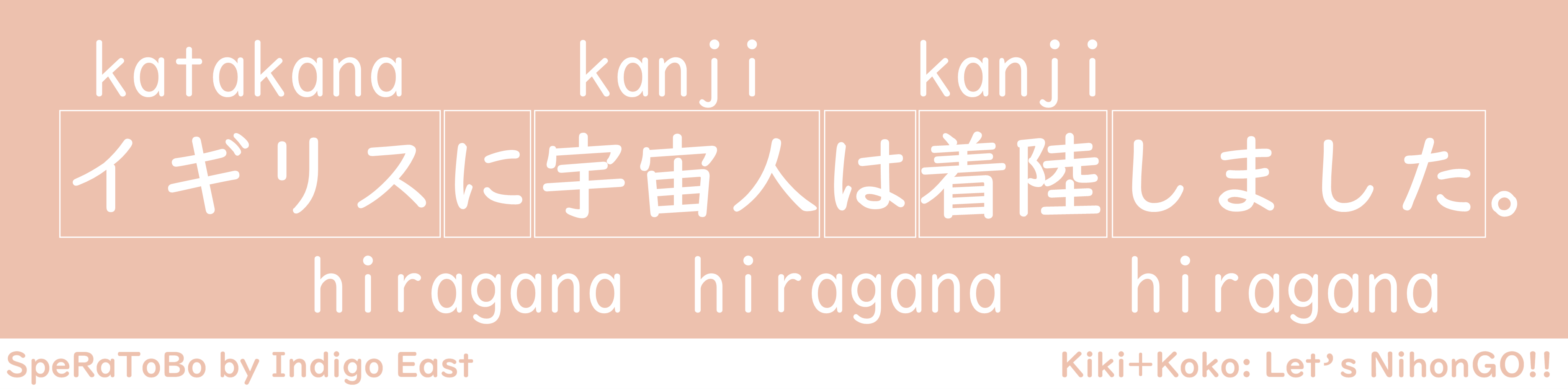
イギリスに宇宙人は着陸しました。
The aliens have landed in England
While that’s technically all of the writing systems you’d need to know, there is another. Another far more dangerous. Rōmaji. (ローマ字 ) Okay, so it’s actually quite integral in an international sort of way. It’s a way for those who use the Roman alphabet--as you’re reading currently– to read Japanese words– Or, if you need to address a parcel from the UK to Japan. While many people may talk down rōmaji, it still has an important place in this global society of ours, but when learning Japanese, it inherently adds far more hurtles…
We’ll definitely go more in-depth in future, since there is still more to know, but hopefully, this demystified what you’ll need to know to hold the proud title of literate in Japanese.
お読みしていだたいてありがとうございました!
Thank you so much for reading!
Be sure to subscribe to our Electronic Mailing List of Tomorrow, today, using the form at the bottom of the web page so you can be the first to see the latest from Kiki+Koko: Let’s NihonGO!!, Indigo East, and SpeRaToBo. And, remember to return back to previous articles and lessons to review/revise.

And, if you would like to assist in keeping these lessons available to as many language learners as possible, please consider supporting us on Patreon at patreon.com/ieindigoeast or leave a TIP in the TIP♡JAR to keep it going if you are in a position to do so. If you cannot support in this way, do not worry, as we are just super happy that you are here! Your participation itself helps to support the content and it is appreciated!
Thank you so much for learning with us!
♡Kiki+Koko

 SpeRaToBo || ieindigoeast
You must be logged in to post a comment.